

Choosing the right eCommerce platform is one of the most important decisions when starting or growing an online store. The platform you select affects your website’s design, performance, payment options, SEO, scalability, maintenance, and overall operating costs.
Two of the most popular options are WooCommerce and Shopify.
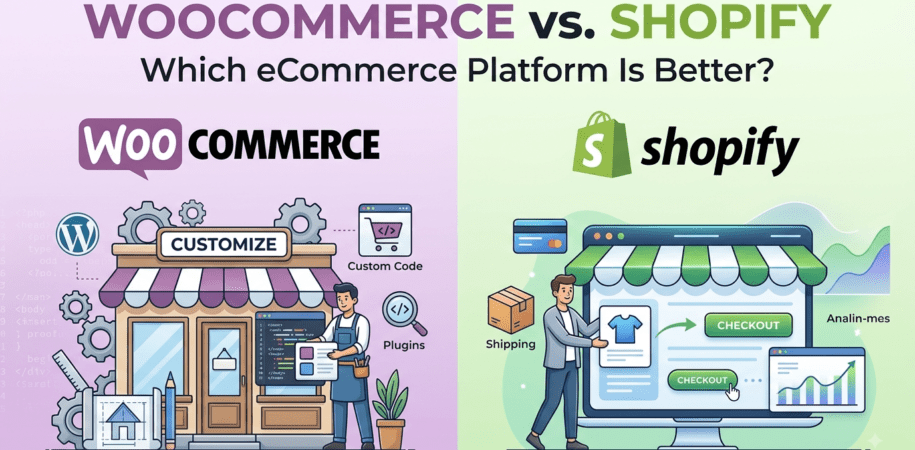
Both platforms can help businesses sell products online, but they work very differently. Shopify is a hosted eCommerce solution designed to make store management simple, while WooCommerce is an eCommerce plugin for WordPress that provides greater control and customization.
So, WooCommerce vs Shopify: which eCommerce platform is better?
The answer depends on your business goals, technical experience, budget, and how much control you want over your online store.
What Is WooCommerce?
WooCommerce is an open-source eCommerce platform built for WordPress websites.
It allows businesses to transform a WordPress website into a fully functional online store. You can add products, manage inventory, configure payments, set shipping options, create discounts, and customize your store’s design.
One of WooCommerce’s biggest advantages is flexibility.
Businesses can customize almost every part of their store using WordPress themes, plugins, custom development, and integrations.
WooCommerce can be particularly useful for businesses that already use WordPress or want complete control over their website.
What Is Shopify?
Shopify is a hosted eCommerce platform that allows businesses to create and manage online stores without having to manage the underlying hosting infrastructure themselves.
Shopify provides tools for:
- Product management
- Inventory
- Payments
- Store design
- Shipping
- Marketing
- Analytics
- Customer management
Because Shopify handles much of the technical infrastructure, it can be easier for beginners and businesses that don’t want to manage hosting, security, and technical maintenance themselves.
WooCommerce vs Shopify: Quick Comparison
| Feature | WooCommerce | Shopify |
|---|---|---|
| Platform type | WordPress plugin | Hosted eCommerce platform |
| Ease of setup | Moderate | Easy |
| Customization | Excellent | Very good |
| Hosting | You manage hosting | Included |
| Technical control | Very high | Moderate |
| Themes | Extensive | Extensive |
| Plugins/Apps | Large ecosystem | Large app ecosystem |
| SEO flexibility | Excellent | Good |
| Scalability | Highly flexible | Highly scalable |
| Maintenance | More hands-on | Mostly managed |
| Best for | Custom stores & WordPress users | Simpler store management |
1. Ease of Use
When comparing WooCommerce vs Shopify, ease of use is one of the biggest differences.
Shopify
Shopify is designed to make launching an online store relatively straightforward.
You don’t need to separately arrange hosting or install WordPress. Much of the technical infrastructure is managed by Shopify.
This makes Shopify attractive to:
- Beginners
- Small businesses
- Entrepreneurs
- Businesses without an in-house developer
WooCommerce
WooCommerce requires a WordPress website and hosting environment.
You’ll generally need to manage or arrange:
- WordPress
- Hosting
- SSL
- Updates
- Backups
- Security
- Plugins
- Themes
That provides more control, but it also means there are more technical responsibilities.
Winner for ease of use: Shopify
2. Customization
If customization is your priority, WooCommerce has a major advantage.
Because WooCommerce operates within WordPress, developers can customize the store’s functionality, design, database, checkout experience, integrations, and other components.
You can also use thousands of WordPress plugins and WooCommerce extensions.
Shopify provides plenty of customization options as well, but there are more platform-level limitations compared with having direct control over a WordPress installation.
Winner for customization: WooCommerce
3. Pricing and Overall Costs
Cost is another important factor in the WooCommerce vs Shopify comparison.
WooCommerce itself is open-source and available without a platform license fee, but running a WooCommerce store still involves costs such as:
- Hosting
- Domain
- Premium themes
- Paid plugins
- Payment processing
- Security
- Development
- Maintenance
Shopify uses a subscription-based model, with different plans depending on the features and requirements of your business.
You may also have costs associated with:
- Premium themes
- Apps
- Payment processing
- Additional services
Therefore, it’s important to compare the total cost of running the store, rather than simply comparing the base platform prices.
Winner: Depends on your requirements
4. SEO
SEO is essential for eCommerce businesses because organic search can generate consistent traffic without requiring you to pay for every visitor.
WooCommerce benefits from the broader WordPress ecosystem and gives you extensive control over:
- URLs
- Metadata
- Content
- Categories
- Blog content
- Internal links
- Structured data
- Technical SEO
Shopify also supports important SEO features and can perform very well in search engines. However, some technical aspects are more controlled by the platform.
If SEO flexibility and content marketing are major priorities, WooCommerce can be particularly attractive.
Winner for SEO flexibility: WooCommerce
5. Design and Themes
Both platforms offer professionally designed themes.
Shopify provides a range of themes that can be customized to suit different businesses and industries.
WooCommerce benefits from the huge WordPress theme ecosystem, giving businesses a wide variety of design possibilities.
WooCommerce can be particularly useful when a business wants a highly customized website that combines:
eCommerce + Blog + Landing Pages + Content Marketing + Custom Features
Winner: Tie
6. Security
Security is extremely important for any eCommerce website because stores process customer information and payments.
Shopify manages much of the technical security infrastructure for you.
With WooCommerce, security becomes more dependent on your WordPress hosting environment, plugins, themes, updates, configuration, and maintenance practices.
A properly maintained WooCommerce website can be secure, but it requires more responsibility from the website owner or development team.
Winner for managed security: Shopify
7. Scalability
Both platforms can support growing businesses.
WooCommerce offers extensive control over hosting infrastructure and website architecture, making it possible to build highly customized solutions.
Shopify is also designed to support businesses as they grow and offers different solutions and plans for larger organizations.
The better choice depends on your store’s technical requirements, product catalog, traffic, integrations, and operational needs.
Winner: Tie
8. Payment Options
Both WooCommerce and Shopify support multiple payment methods.
Depending on your country and business model, you can integrate payment gateways such as:
- Credit/debit cards
- PayPal
- Stripe
- Local payment gateways
- Bank payments
- Other third-party payment providers
The exact availability and transaction costs depend on your location, payment provider, and platform plan.
Before choosing an eCommerce platform, check whether your preferred payment gateway is supported in your target market.
9. Plugins vs Apps
WooCommerce uses the WordPress plugin ecosystem and WooCommerce extensions.
These can add functionality such as:
- SEO
- Email marketing
- Product filters
- Subscriptions
- Booking systems
- Memberships
- Payment gateways
- Shipping
- Analytics
Shopify uses apps to extend store functionality.
Its app ecosystem can help businesses add:
- Marketing tools
- Product reviews
- Email automation
- Inventory tools
- Customer support
- Analytics
- Shipping solutions
Both ecosystems are extensive.
The key difference is that WooCommerce generally gives developers more direct control over the underlying WordPress environment.
10. WooCommerce vs Shopify for Small Businesses
For a small business owner who wants to launch quickly without dealing with technical maintenance, Shopify can be an excellent option.
You can focus more on:
- Products
- Customers
- Marketing
- Sales
rather than hosting and technical administration.
WooCommerce may be better for small businesses that already have a WordPress website or want a highly customized online store.
11. WooCommerce vs Shopify for Large Businesses
Large businesses should evaluate more than just the initial setup.
Important considerations include:
- Product volume
- Website traffic
- International selling
- Payment processing
- ERP integrations
- CRM integrations
- Inventory management
- Custom functionality
- Performance
- Security
- Development requirements
Both platforms can support serious eCommerce operations, but the best option depends heavily on the business’s technology stack and long-term requirements.
12. Which Platform Is Better for SEO?
If your business plans to rely heavily on SEO and content marketing, WooCommerce can be an excellent choice.
The combination of WordPress and WooCommerce allows businesses to build:
Product Pages + Blog Content + Landing Pages + SEO Content + Internal Linking
This can make it easier to create a comprehensive content strategy.
However, Shopify can also rank successfully in Google when its store is properly optimized.
The platform itself isn’t enough to guarantee rankings. SEO still depends on:
- Content quality
- Search intent
- Technical SEO
- Website performance
- Backlinks
- Internal linking
- Product optimization
- User experience
13. Which Is Better for Dropshipping?
Both platforms can support dropshipping businesses.
Shopify is often attractive because of its simple setup and integrations with eCommerce and fulfillment tools.
WooCommerce can offer more customization and flexibility, especially when a business wants to create a customized workflow.
The right choice depends on your supplier integrations, product catalog, fulfillment process, and marketing strategy.
14. Which Platform Is Better for Beginners?
If you’re completely new to eCommerce and don’t want to deal with hosting or technical maintenance, Shopify is generally easier to get started with.
WooCommerce has a steeper learning curve because you’re working within WordPress and managing additional components.
However, once properly configured, WooCommerce can provide a highly flexible store environment.
15. Which Platform Is Better for Developers?
For developers who want maximum control, WooCommerce is usually the more flexible option.
Developers can work with WordPress and WooCommerce to create custom:
- Checkout experiences
- Product functionality
- Integrations
- APIs
- Customer experiences
- Store features
Shopify also provides strong development capabilities, but within its platform architecture.
Winner for development flexibility: WooCommerce
WooCommerce vs Shopify: Which One Should You Choose?
There isn’t one platform that’s perfect for every business.
Choose WooCommerce if you:
- Already use WordPress
- Want maximum customization
- Need extensive SEO control
- Want complete ownership of your website environment
- Need custom integrations
- Have access to developers
- Want to build a content-heavy eCommerce website
Choose Shopify if you:
- Want a simpler setup
- Don’t want to manage hosting
- Prefer a managed platform
- Want to launch quickly
- Don’t have extensive technical expertise
- Prefer a centralized eCommerce dashboard
Final Verdict
So, WooCommerce vs Shopify: which eCommerce platform is better?
The answer depends on your business.
Shopify is a strong choice for businesses that prioritize simplicity, fast setup, and managed infrastructure.
WooCommerce is a strong choice for businesses that prioritize customization, WordPress integration, SEO flexibility, and greater technical control.
For businesses planning a highly customized website with a strong content and SEO strategy, WooCommerce can be an excellent option.
For businesses that want to get an online store running quickly with less technical management, Shopify may be the better fit.
Ultimately, the best eCommerce platform is the one that fits your budget, technical capabilities, business model, marketing strategy, and long-term growth plans.
Looking to Build an eCommerce Website?
Choosing the platform is only the beginning. A successful online store also needs strong design, mobile responsiveness, SEO, speed, secure payments, conversion-focused product pages, and a strategy for attracting customers.
A professional eCommerce development team can help you evaluate your requirements and choose the right platform before development begins.