
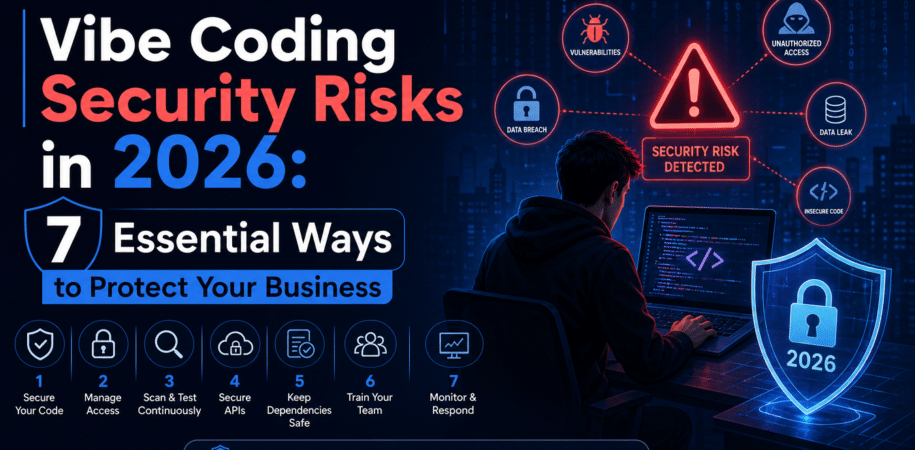

Imagine launching a business application in a single afternoon. An AI tool writes the code, creates the interface, and connects the database. Everything looks professional, and the application appears ready for customers. But behind that polished interface, a forgotten access rule could expose customer records, an unverified package could introduce malware, or an exposed API key could give attackers access to business systems.
This is the challenge of vibe coding security risks in 2026. AI-powered development tools make it easier to build software using natural-language prompts, but faster development does not automatically produce secure software.
For businesses investing in website development, custom applications, and digital transformation, understanding these risks is essential. An application that works during a demonstration may still contain vulnerabilities that become apparent only after deployment.
The solution is not to abandon AI coding tools. Businesses need a structured approach that combines AI-assisted development with human code review, security testing, controlled permissions, and ongoing monitoring.
In this guide, we explain seven major vibe coding security risks, practical ways to reduce them, and what businesses should check before deploying AI-generated software.
What Is Vibe Coding?
Vibe coding is a software development approach in which a person describes an application or feature in ordinary language and uses artificial intelligence to generate much of the underlying code.
Instead of manually writing every function, a developer might ask an AI tool to create a customer login page, build an inventory dashboard, or connect an online store to a database. The tool generates code that can then be tested, revised, and expanded through additional prompts.
The term became widely known in February 2025 after Andrej Karpathy, an AI researcher and OpenAI co-founder, described the approach in a post on X.
Vibe coding can help founders, designers, small businesses, and experienced developers turn ideas into prototypes quickly. However, the risks increase when users accept generated code without understanding its behavior or verifying its security.
Vibe Coding vs. Traditional Software Development
The main difference is not simply who writes the code. It is how much human understanding, review, and control remain throughout development.
| Area | Vibe Coding | Traditional Software Engineering |
|---|---|---|
| Code creation | AI generates substantial portions of code from prompts | Developers typically write and maintain code directly |
| Development speed | Often faster for prototypes and straightforward features | May require more time for manual implementation |
| Code understanding | Can be limited if generated output is not reviewed | Developers are expected to understand the code they maintain |
| Security testing | May be overlooked without a defined process | Can be integrated into established development workflows |
| Accountability | Requires an explicit owner despite AI involvement | Usually assigned through engineering roles and release procedures |
These approaches are not mutually exclusive. Professional developers can use AI to accelerate implementation while retaining responsibility for architecture, testing, and security.
The most effective approach combines AI-generated productivity with established software engineering practices.
Why Are Vibe Coding Security Risks Increasing in 2026?
AI coding tools can generate convincing code without guaranteeing that the result follows secure development practices. A feature may satisfy its visible requirements while missing important protections behind the interface.
The National Institute of Standards and Technology (NIST) publishes the Secure Software Development Framework, which recommends integrating security throughout the software development life cycle rather than treating it as a final step.
NIST also published a generative AI-specific extension, SP 800-218A, in July 2024. It provides additional secure development practices relevant to AI systems and their life cycles.
These frameworks reinforce an important principle: security must be designed, checked, and maintained throughout development.
Source: NIST Secure Software Development Framework and NIST SP 800-218A.
Several factors make security particularly important for AI-generated applications:
- Incomplete requirements: A prompt may describe a feature without specifying authorization, data validation, or session management.
- Unverified code: Generated functions can contain weaknesses even when they appear to work correctly.
- Third-party dependencies: AI tools may recommend inappropriate, outdated, or potentially malicious packages.
- Excessive permissions: Coding agents may receive access to files, credentials, databases, or external services they do not need.
- Limited ownership: Teams may struggle to maintain code that nobody has fully reviewed or documented.
These problems are manageable when businesses identify them early and establish clear controls before deployment.
What Are the 7 Major Vibe Coding Security Risks?
1. Insecure AI-Generated Code
The first risk is assuming that functional code is secure code.
An AI-generated application may display information correctly, process orders, or save customer details while containing vulnerabilities in the underlying implementation.
For example, an AI-built customer portal might retrieve account information from a database without checking whether the logged-in user owns the requested record. The page works as intended for a legitimate user, but a malicious visitor may manipulate a request to access someone else’s information.
Common weaknesses include:
- SQL injection and unsafe database queries.
- Cross-site scripting (XSS).
- Improper input validation.
- Insecure error handling.
- Weak session management.
- Insufficient authorization checks.
How to reduce the risk: Require developers to review generated code, validate user inputs, use parameterized database queries, and test security-sensitive functions. Automated static application security testing (SAST) can identify many common coding weaknesses before release.
2. Exposed API Keys and Database Credentials
AI coding tools sometimes generate configuration examples containing credentials directly in source files. Developers may also paste actual secrets into prompts while asking an AI assistant to troubleshoot an integration.
If these credentials enter a public repository, application logs, or an exposed client-side bundle, attackers may use them to access databases, cloud services, payment systems, or other business resources.
Consider an AI-generated website that connects to a cloud database. If the developer places an unrestricted database key inside browser-facing JavaScript, visitors may be able to inspect the code and extract it.
How to reduce the risk:
- Store secrets in environment variables or a dedicated secrets manager.
- Never embed private credentials in frontend code.
- Enable automated secret scanning for repositories.
- Rotate credentials immediately if exposure is suspected.
- Apply minimum necessary permissions to every credential.
- Avoid including customer data or production secrets in AI prompts.
Businesses should also review historical commits because deleting a secret from the latest version does not necessarily remove it from the repository’s history.
3. Malicious or Hallucinated Software Dependencies
AI coding assistants may recommend packages that are outdated, unsuitable, compromised, or nonexistent. An attacker can sometimes exploit this behavior by registering a package name that a developer expects to exist.
This technique is known as slopsquatting: malicious actors attempt to exploit AI-generated recommendations for nonexistent software packages.
The danger is straightforward. A developer asks an AI tool to add a feature, receives an unfamiliar package name, and installs it without checking the official package registry. If the package is malicious, the application or development environment may be compromised.
Dependencies also create risks when legitimate packages contain known vulnerabilities or are maintained poorly.
How to reduce the risk:
- Verify package names against official registries.
- Review package maintainers, release history, and documentation.
- Pin dependency versions and commit lockfiles.
- Run software composition analysis (SCA) to identify vulnerable components.
- Remove unnecessary libraries.
- Review dependency changes before merging generated code.
For business-critical applications, dependency verification should be a standard part of the development pipeline.
4. Missing Authentication and Broken Access Controls
Authentication determines who can sign in. Authorization determines what an authenticated person can access.
AI-generated applications may implement a login screen while failing to protect individual API endpoints or database records. A professional-looking interface can therefore create a misleading sense of security.
Imagine an internal HR application built using an AI coding assistant. Employees can log in successfully, but the backend does not verify employee permissions before returning salary records. The application has authentication, yet its authorization controls are inadequate.
Other examples include administrator pages accessible to ordinary users, forgotten password-reset protections, and APIs that return private information without validating ownership.
How to reduce the risk:
- Define user roles and permissions before generating code.
- Enforce authorization on the server, not just in the interface.
- Apply least-privilege access to databases and APIs.
- Test with separate accounts representing different user roles.
- Check that unauthenticated requests cannot access protected resources.
- Conduct penetration testing before launching sensitive applications.
For applications handling financial, personal, or confidential business information, access-control testing should be a release requirement.
5. Over-Permissioned AI Coding Agents
Some AI development environments can perform more than generate text. Depending on their configuration, agents may execute commands, modify files, install packages, access APIs, and interact with connected databases.
This capability creates a risk when an agent receives more access than its task requires.
For example, an AI agent asked to update a database schema might also possess credentials for a live production database. A mistaken command or poorly constrained action could delete records or disrupt a service.
The underlying problem is not necessarily malicious AI behavior. It is the combination of powerful permissions, limited safeguards, and insufficient human oversight.
How to reduce the risk:
- Use isolated development and testing environments.
- Keep production credentials separate from development credentials.
- Give agents the minimum permissions necessary.
- Require human approval for destructive or high-impact operations.
- Maintain backups and test restoration procedures.
- Record important agent actions and tool executions.
AI agents should not automatically receive unrestricted administrative access merely because it makes development more convenient.
6. Prompt Injection and Untrusted AI Tools
AI coding agents may read external documentation, issue descriptions, repository files, web pages, and tool responses. Some of that content can contain instructions designed to manipulate the agent.
This is known as prompt injection. An attacker may attempt to convince an AI system to reveal sensitive information, execute an unsafe command, or disregard its original task.
Connected tools and Model Context Protocol (MCP) servers can expand the potential attack surface when they allow agents to interact with external systems.
For instance, an agent reviewing an unfamiliar repository could encounter malicious instructions hidden in a project file. If the agent has access to secrets or command execution, following those instructions could cause damage.
How to reduce the risk:
- Use approved and trusted AI integrations.
- Review MCP servers, extensions, and tool permissions before installation.
- Do not treat external content as trusted instructions.
- Keep secrets outside the agent’s accessible context whenever possible.
- Restrict network access and command execution where practical.
- Require confirmation before sensitive actions.
Businesses should regularly review connected tools because an application’s security depends partly on the systems and services its AI agents can access.
7. Missing Monitoring, Documentation, and Maintenance
Security does not end when an application goes live. AI-generated software can become vulnerable as dependencies change, new weaknesses are discovered, and business requirements evolve.
A team might launch a working application without documenting its architecture, tracking dependencies, recording security decisions, or assigning responsibility for future updates.
When a vulnerability appears, the absence of documentation makes it harder to identify affected components and deploy a reliable fix.
How to reduce the risk:
- Maintain a version-controlled code repository.
- Document important architecture and security decisions.
- Monitor application logs and security alerts.
- Update dependencies and frameworks regularly.
- Establish a process for reporting and fixing vulnerabilities.
- Assign a named owner for maintenance and incident response.
- Keep tested backups and a documented recovery plan.
Reliable maintenance turns security from a one-time activity into an ongoing business process.
How Do These Vibe Coding Security Risks Compare?
The following table summarizes the primary warning signs and the first control businesses should implement.
| Security risk | Warning sign | Recommended first control |
|---|---|---|
| Insecure code | Features work, but security tests fail | Code review and SAST |
| Exposed credentials | Secrets appear in source files or prompts | Secret scanning and a secrets manager |
| Unsafe dependencies | Unverified or suspicious packages are installed | Registry verification and SCA |
| Broken access controls | Users can access records they do not own | Server-side authorization testing |
| Excessive agent permissions | An agent can modify production resources unnecessarily | Least privilege and environment isolation |
| Prompt injection | Untrusted content can trigger sensitive tool actions | Restrict tools and require approval |
| Poor maintenance | No clear owner, update process, or recovery plan | Monitoring, documentation, and ownership |
The best results come from applying these controls together. No individual scanner or security tool can detect every vulnerability.
How Can Businesses Reduce Vibe Coding Security Risks?
The seven risks above can be addressed through a repeatable secure development process. Businesses do not need to eliminate AI from their workflow; they need to make sure generated code passes the same essential security checks as other software.
1. Write Security Requirements Into Every Prompt
AI coding tools work from the instructions they receive. A request that focuses exclusively on functionality may overlook important security requirements.
Instead of asking an AI tool to build a login system, specify that it must use secure password handling, server-side authorization, input validation, appropriate session controls, and protected error responses.
A reusable instruction could be:
“Generate maintainable code that follows secure development practices. Validate all untrusted input, use parameterized database queries, enforce authorization on the server, keep secrets out of source code, and document security assumptions. Identify any requirements that cannot be safely implemented and explain the necessary tests.”
A detailed prompt helps communicate expectations, but it does not guarantee a secure result. Every generated feature still requires verification.
2. Require Human Code Review
A human reviewer should understand what generated code does, how it handles sensitive data, and whether it introduces unexpected behavior.
Reviews should pay particular attention to authentication, authorization, payment processing, database queries, file uploads, and external integrations.
Reviewers should also check whether generated code introduces unnecessary dependencies or changes existing security controls.
For larger applications, use pull requests and require an approved review before merging important changes into the main branch.
Practical rule: No AI-generated code should reach production solely because it compiles or passes a demonstration.
3. Automate Security Testing
Automated security tools help identify recurring problems without relying entirely on manual inspection.
A practical security pipeline can include:
- SAST: Examines source code for common vulnerabilities.
- SCA: Identifies vulnerable or outdated third-party dependencies.
- Secret scanning: Detects exposed API keys, tokens, and credentials.
- DAST: Tests a running application for exploitable weaknesses.
- Automated tests: Check expected behavior, permissions, and regression risks.
Tools such as Semgrep, Snyk, GitGuardian, and OWASP ZAP can support different parts of this workflow.
Run appropriate checks when code changes, and establish clear rules for handling high-severity findings. A scan is useful only when the team investigates and resolves the problems it identifies.
4. Protect Data and Restrict AI Permissions
Use separate development, staging, and production environments whenever the application’s risk justifies them.
AI agents should work with test data and limited credentials by default. Access to production databases, payment systems, cloud infrastructure, and customer records should be restricted and explicitly authorized.
Store credentials in a dedicated secrets manager or the platform’s secure configuration system. Never assume that an AI-generated configuration is safe merely because the tool created it.
For critical operations, require approval, preserve audit logs, and maintain tested recovery procedures.
5. Verify Dependencies and Third-Party Integrations
Before installing a suggested library or connecting a new service, establish that it is legitimate and appropriate for the project.
Check the package’s official registry entry, maintenance status, version history, and security advisories. Review the permissions required by plugins, extensions, and MCP servers before connecting them to an AI agent.
Where possible, pin dependency versions, minimize unnecessary integrations, and monitor components for newly disclosed vulnerabilities.
This process reduces the likelihood that a convenient AI-generated recommendation introduces an avoidable supply-chain risk.
6. Test Security Before Every Production Release
Security requirements should be part of the release checklist rather than an optional final review.
A release gate for a customer-facing application should confirm that:
- Relevant automated security checks have passed or findings have been formally assessed.
- Secrets are not exposed in the code or client-side application.
- Authentication and authorization tests cover important user roles.
- Dependencies have been reviewed for known vulnerabilities.
- Sensitive actions and administrative access are restricted.
- Backups and rollback procedures are available.
- A named person has approved the release.
Higher-risk systems may also require an independent penetration test and specialist compliance review.
7. Monitor, Update, and Assign Responsibility
Once the application is live, assign responsibility for updates, vulnerability reports, access reviews, and incident response.
Maintain an inventory of deployed applications, track dependency changes, and monitor relevant security events. Review access permissions when team members change roles or leave the organization.
For important applications, establish recovery objectives and test whether backups can actually restore the service and its data.
NIST’s Secure Software Development Framework provides a useful foundation for organizing these activities across the software development life cycle.
How Should You Evaluate an IT Services Company for Secure AI Development?
Businesses that lack dedicated security engineers may benefit from working with an experienced IT services provider. However, a polished demo or a promise of fast delivery does not demonstrate that a company follows secure development practices.
When evaluating providers, ask them to explain how they manage AI-generated code, protect business data, and prepare applications for production.
Use the following checklist when comparing potential partners.
Code review and ownership
- Does a qualified developer review security-sensitive AI-generated code?
- Is a specific person accountable for approving the release?
- Will your business receive access to the source code and documentation?
Security testing
- Does the development workflow include code scanning, dependency analysis, and secret detection?
- Are authentication and authorization tested separately?
- Is penetration testing available for higher-risk applications?
Data and infrastructure protection
- Are development and production environments separated?
- How are credentials, customer data, and AI prompts protected?
- Can AI agents access production resources, and what controls restrict them?
Maintenance and support
- Are software updates and vulnerability fixes included in the service agreement?
- Are backups, monitoring, and incident response responsibilities documented?
- Is there a clear process for addressing security issues discovered after launch?
Evidence and transparency
- Can the provider demonstrate its development and release process?
- Are testing results and identified risks documented?
- Can it provide relevant client references and evidence of applicable certifications?
Choose a provider based on demonstrated processes, appropriate technical expertise, and transparent responsibilities rather than development speed alone.
For businesses seeking assistance with website development, application development, infrastructure management, or ongoing IT support, Ziffs Trading can position security as an essential part of reliable technology delivery. The appropriate scope depends on the project, the sensitivity of its data, and the level of assurance the business requires.
Frequently Asked Questions About Vibe Coding Security Risks
1. Is vibe coding safe for business applications?
Vibe coding can be suitable for business applications when the development process includes appropriate code review, testing, access controls, and maintenance. Internal prototypes using synthetic data generally present less exposure than public applications handling financial or personal information. Production deployment should depend on the application’s risk and the evidence that its security requirements have been met.
2. What are the biggest vibe coding security risks?
The main risks include insecure generated code, exposed credentials, malicious or vulnerable dependencies, missing authentication, excessive AI-agent permissions, prompt injection, and inadequate maintenance. The relative importance of each risk depends on the application’s architecture, data, integrations, and deployment environment.
3. Can AI-generated code contain security vulnerabilities?
Yes. AI models can generate code that works functionally but contains insecure database queries, missing authorization checks, unsafe input handling, or other weaknesses. Code generation should therefore be followed by human review and suitable automated testing before deployment.
4. How can small businesses secure AI-built websites?
Small businesses should use trusted development tools, keep secrets out of public code, enforce server-side access controls, verify third-party dependencies, and enable automated security scanning. They should also maintain backups, update software regularly, and seek specialist testing when the website handles sensitive information or important business transactions.
5. Which tools help detect vibe coding security risks?
Different tools address different problems. Semgrep supports static code analysis, Snyk helps identify vulnerable dependencies, GitGuardian detects exposed secrets, and OWASP ZAP supports dynamic application security testing. These tools complement rather than replace code review, architecture decisions, and appropriate security expertise.
6. Does AI-assisted coding replace cybersecurity professionals?
No. AI tools can help developers identify problems, generate tests, and implement fixes, but they can also overlook vulnerabilities or introduce new ones. Cybersecurity professionals provide independent assessment, risk prioritization, and expertise for complex systems. AI-assisted checks are most useful when combined with human judgment and repeatable testing.
7. Should businesses hire an IT services provider to review AI-generated applications?
An external review can be valuable when an organization lacks the expertise or independence needed to assess an application. The provider should understand the technology stack, data sensitivity, deployment environment, and relevant compliance obligations. Before hiring, confirm the review scope, expected deliverables, remediation responsibilities, and whether retesting is included.
Final Thoughts: Build Faster Without Compromising Security
Vibe coding is changing how businesses turn ideas into digital products. It can shorten development cycles, make prototyping more accessible, and help technical teams deliver features faster.
However, the speed of generating code should never be confused with proof that the code is secure.
The most important vibe coding security risks arise when teams overlook code review, expose credentials, trust unverified dependencies, grant AI agents excessive permissions, or deploy applications without testing their access controls.
Businesses can reduce these risks by establishing security requirements early, reviewing generated code, automating relevant scans, protecting sensitive data, testing every release, and assigning clear responsibility for maintenance.
These safeguards allow organizations to benefit from AI-assisted development while maintaining the accountability required for reliable business software.
For organizations planning a new website, custom application, or wider IT modernization project, security should be part of the development plan from the beginning. Working with a capable IT services partner can help establish the processes, monitoring, and technical controls needed to keep applications secure as they grow.
Build efficiently, verify every release, and make security a requirement—not an afterthought.
References and Further Reading
- NIST Secure Software Development Framework (SSDF)
- NIST SP 800-218A: Secure Software Development Practices for Generative AI and Dual-Use Foundation Models
- NIST SP 800-218: Secure Software Development Framework, Version 1.1
Editorial note: This article focuses on practical security controls rather than unverified 2026 statistics. Tool capabilities and security guidance should be checked against current vendor documentation before implementation.