
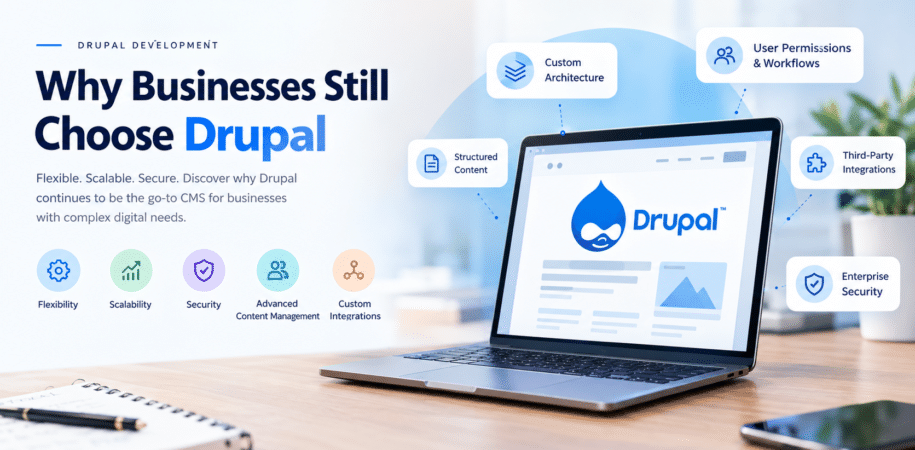

Choosing the right content management system is an important decision for businesses building or upgrading a website. While there are many CMS platforms available today, Drupal development continues to be used for websites that require flexibility, scalability, strong content management, and advanced functionality.
From corporate websites and educational platforms to government portals and large content-driven websites, Drupal can provide a powerful foundation for organizations with more complex digital requirements.
What Is Drupal?
Drupal is an open-source content management system (CMS) used to build, manage, and publish digital content. It provides businesses and developers with tools for creating websites that can be customized according to specific organizational requirements.
Unlike platforms designed primarily for simple websites, Drupal offers extensive options for managing structured content, user permissions, workflows, integrations, and complex website architectures.
Why Businesses Use Drupal Development
1. Flexible Website Architecture
One of the main advantages of Drupal development is flexibility. Developers can create customized content types, layouts, user roles, workflows, and website functionality.
This makes Drupal suitable for organizations that need more than a basic brochure website.
Businesses can build websites around their specific content and operational requirements rather than forcing their processes into a rigid website structure.
2. Scalable for Growing Businesses
A business website may start with a relatively small amount of content but grow significantly over time. Drupal provides a foundation that can accommodate expanding content, users, functionality, and integrations.
This scalability can be particularly useful for organizations managing large websites or multiple content categories.
3. Strong Content Management
Drupal provides sophisticated content management capabilities. Businesses can organize different types of information and create structured content that can be reused across different areas of a website.
For organizations publishing large amounts of content, this can make website management more organized and efficient.
4. Advanced User Permissions
Businesses often have multiple employees, editors, managers, and administrators working on their websites.
Drupal allows organizations to create different user roles and permissions. For example, a content editor can be given access to manage articles while an administrator maintains broader control over the website.
This level of access management can help organizations establish structured publishing workflows.
5. Custom Integrations
Modern business websites often need to communicate with other systems such as CRM platforms, marketing tools, payment systems, databases, analytics platforms, and third-party APIs.
Drupal can be customized to integrate with external systems, allowing businesses to create websites that are connected to their broader technology infrastructure.
Drupal and Website Security
Security is an important consideration for any business website. Because Drupal is used for websites with different levels of complexity, maintaining the CMS, modules, integrations, and server environment is essential.
Businesses using Drupal should keep their website components updated, monitor security announcements, use appropriate access controls, and maintain reliable backups.
Professional Drupal development and maintenance can also help organizations identify technical issues and keep their websites properly maintained.
Is Drupal Good for SEO?
Drupal can support search engine optimization when it is properly configured and developed.
A Drupal website can be structured with SEO-friendly URLs, metadata, organized content, responsive layouts, and performance optimization.
However, a CMS alone does not guarantee search rankings. Technical SEO, content quality, website performance, keyword targeting, internal linking, backlinks, and ongoing optimization all contribute to organic search performance.
Drupal vs. Other CMS Platforms
Different CMS platforms are designed for different requirements.
Some businesses may prefer a simpler CMS because they need a straightforward website that can be managed with minimal technical involvement. Other organizations may need advanced content structures, permissions, integrations, and customization.
Drupal can be particularly useful when a website requires a more customized architecture or needs to manage complex content and user workflows.
The right CMS ultimately depends on the organization’s budget, technical requirements, content strategy, scalability needs, and long-term goals.
When Should a Business Consider Drupal?
Drupal may be worth considering when a business or organization needs:
- Complex content structures
- Multiple user roles and permissions
- Custom website functionality
- Advanced publishing workflows
- Third-party integrations
- Large amounts of structured content
- A scalable website architecture
- Ongoing customization and development
For a small website with only a few pages and basic functionality, a simpler platform may be sufficient. For organizations with more advanced requirements, Drupal can provide greater flexibility.
Why Professional Drupal Development Matters
Installing a CMS is only one part of building a successful business website. The website architecture, modules, integrations, performance, security, responsive design, and content structure all need to work together.
Professional Drupal development services can help businesses plan the website architecture, develop custom functionality, integrate external systems, optimize performance, and maintain the platform over time.
Regular maintenance is also important. Businesses should monitor updates, backups, security issues, performance, and compatibility as their website evolves.
Final Thoughts
Drupal remains a flexible option for businesses and organizations that need a powerful content management system with advanced customization and scalability.
The biggest benefit of Drupal development is its ability to adapt to complex website requirements. With the right development strategy and ongoing maintenance, Drupal can support content-heavy websites, custom workflows, integrations, and long-term digital projects.
Before choosing Drupal, businesses should evaluate their technical requirements, budget, content structure, security needs, and future growth plans. This helps ensure the selected CMS is appropriate for both current requirements and future website development.