
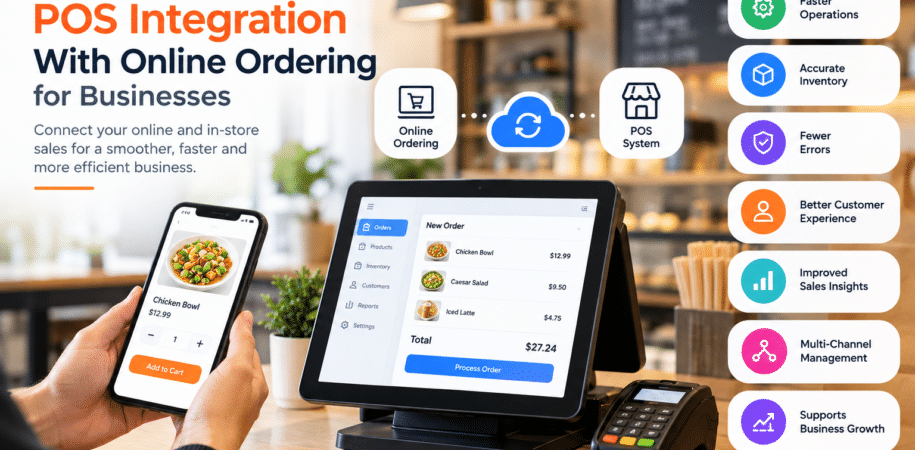

Online ordering has become an important part of modern business operations, particularly for restaurants, retail stores, cafés, and other businesses that process frequent customer orders. However, managing online orders separately from in-store sales can create unnecessary work, inaccurate inventory records, and operational delays.
This is where POS integration with online ordering can make a significant difference.
By connecting an online ordering system directly with a point-of-sale (POS) system, businesses can centralize orders, inventory, payments, and customer information in one connected system. Instead of manually entering online orders into the POS, businesses can automate much of the process and improve the overall customer experience.
What Is POS Integration With Online Ordering?
POS integration with online ordering connects a business’s online ordering platform with its point-of-sale system. When a customer places an order through a website, mobile app, or other online channel, the order can be sent directly to the POS system for processing.
Depending on the system, the integration can also synchronize product information, prices, inventory levels, order status, and payment information.
For businesses handling orders through multiple channels, this creates a more efficient and centralized workflow.
1. Centralizes Online and In-Store Orders
One of the biggest benefits of POS integration with online ordering is centralized order management.
Without integration, employees may need to monitor online orders separately and manually enter them into the POS system. This can take additional time and increase the possibility of mistakes.
With an integrated system, online and in-store orders can be managed through a connected workflow.
This allows employees to spend less time switching between systems and more time serving customers.
2. Reduces Order Entry Errors
Manual order entry can result in incorrect products, quantities, prices, or customer information.
A connected POS system can automatically transfer online orders into the business’s order management workflow. This reduces repetitive data entry and minimizes the risk of human error.
More accurate orders can lead to fewer customer complaints, refunds, and order corrections.
3. Keeps Inventory More Accurate
Inventory management becomes more difficult when a business sells products through multiple channels.
For example, a restaurant may receive orders through its website while also accepting orders at the counter. A retail business may sell the same products online and in-store.
Without proper integration, inventory information can quickly become outdated.
POS integration with online ordering can help synchronize sales and inventory data across channels. When an item is sold, inventory information can be updated automatically, depending on the capabilities of the POS and ordering platforms.
This can help businesses reduce overselling and improve inventory visibility.
4. Improves Order Processing Speed
Customers expect online orders to be processed quickly.
When employees manually transfer online orders into another system, processing can take longer. An integrated POS solution can automatically send orders to the appropriate workflow, allowing staff to begin preparing or fulfilling them sooner.
Faster processing can improve operational efficiency and create a smoother experience for customers.
5. Creates a Better Customer Experience
Customer experience is increasingly important in a competitive digital marketplace.
Customers want ordering to be simple, accurate, and convenient. They also expect businesses to provide accurate product availability and timely order updates.
By connecting online ordering with the POS system, businesses can create a more consistent ordering process.
Customers can place orders online while employees receive the necessary information through the business’s normal operational system.
6. Simplifies Payment Management
Online ordering can involve multiple payment methods, including credit cards, digital wallets, and other electronic payment options.
An integrated system can help businesses connect online transactions with their broader sales records.
This can make it easier to track orders and payments while reducing the need to reconcile information from multiple disconnected systems.
Businesses should ensure that their chosen POS and online ordering platforms support the payment methods and reporting features they require.
7. Provides Better Sales Data
Data is one of the most valuable resources for modern businesses.
A connected POS and online ordering system can provide businesses with a more complete view of sales activity across different channels.
Businesses can analyze information such as:
- Online and in-store sales
- Best-selling products
- Order volumes
- Customer purchasing patterns
- Peak ordering periods
- Product performance
- Revenue by sales channel
These insights can help business owners make more informed decisions about inventory, marketing, staffing, and promotions.
8. Makes Multi-Channel Selling Easier
Many businesses now operate across several sales channels.
Customers may order through a website, mobile application, social media platform, marketplace, or physical location.
Managing every channel independently can become complicated as a business grows.
POS integration with online ordering helps create a more connected multi-channel operation. Instead of treating every sales channel as a separate system, businesses can connect important sales and operational data.
This can make it easier to scale digital ordering without creating unnecessary administrative work.
9. Saves Employees Time
Employees often spend significant amounts of time performing repetitive administrative tasks.
Manually entering online orders, updating inventory, checking prices, and reconciling sales records can all consume valuable working hours.
Automation through POS integration can reduce these repetitive tasks.
Employees can then focus on activities that require human attention, such as customer service, order preparation, product management, and business operations.
10. Improves Business Reporting
Accurate reporting is essential for understanding business performance.
When sales information is distributed across multiple systems, creating accurate reports can become difficult.
An integrated POS system can bring more sales information into one environment, making it easier to review business performance.
Business owners can use this information to identify trends, evaluate product performance, and make better operational decisions.
11. Supports Business Growth
As a business grows, its technology requirements usually grow as well.
A system that works for a small number of orders may become difficult to manage when order volume increases.
POS integration with online ordering can provide a more scalable operational structure. Businesses can add digital ordering while maintaining a connected system for managing sales and inventory.
This can be particularly valuable for restaurants, cafés, retail businesses, and other companies that are expanding their digital sales channels.
12. Helps Create a More Connected Business
The biggest advantage of POS integration is connectivity.
Instead of having separate systems for online orders, in-store sales, inventory, and reporting, businesses can connect important processes together.
This creates a more organized digital ecosystem and gives business owners greater visibility into day-to-day operations.
How to Choose the Right POS and Online Ordering Integration
Before choosing an integrated solution, businesses should consider their specific operational requirements.
Important factors include:
- Online ordering compatibility
- Inventory synchronization
- Payment integration
- Real-time order management
- Reporting and analytics
- Customer management
- Multi-location support
- Security features
- Ease of use
- Scalability
- Integration with existing business software
The right solution should not simply connect two systems. It should improve the way the business operates.
Is POS Integration With Online Ordering Worth It?
For businesses that receive both online and in-person orders, POS integration with online ordering can provide significant operational advantages.
It can reduce manual work, improve order accuracy, support better inventory management, simplify reporting, and create a more consistent customer experience.
As digital ordering continues to become an important part of modern commerce, businesses can benefit from connecting their online and offline operations through reliable technology.
Final Thoughts
Online ordering can create new opportunities for businesses, but managing multiple sales channels can become challenging without the right technology.
POS integration with online ordering helps businesses connect their sales, inventory, payments, and order management processes. By reducing manual tasks and improving access to business data, an integrated POS solution can help businesses operate more efficiently and serve customers more effectively.
For businesses looking to modernize their operations, investing in connected POS and digital ordering technology can be an important step toward long-term growth.
Frequently Asked Questions
What is POS integration with online ordering?
POS integration with online ordering connects an online ordering platform with a point-of-sale system so that online orders and related sales information can flow into the business’s POS workflow.
What are the main benefits of POS integration?
The main benefits include faster order processing, fewer manual entry errors, improved inventory visibility, centralized order management, better reporting, and a smoother customer experience.
Can POS integration help with inventory management?
Yes. Depending on the POS and online ordering platforms, integration can synchronize inventory information across sales channels and help businesses maintain more accurate stock records.
Is POS integration useful for restaurants?
Yes. Restaurants can use integrated POS and online ordering systems to manage online and in-person orders through a more connected workflow while improving order accuracy and operational efficiency.
Can POS systems integrate with mobile ordering?
Many modern POS platforms can integrate with mobile ordering applications or mobile-friendly ordering systems. Businesses should verify compatibility before selecting a solution.
How can businesses choose the right POS system?
Businesses should consider their ordering channels, inventory requirements, payment methods, reporting needs, scalability, security, and compatibility with existing software before choosing a POS solution.