
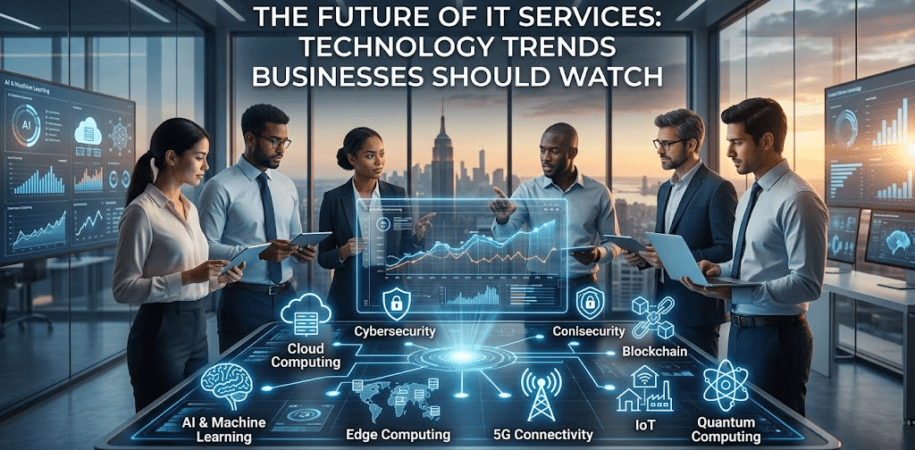

Technology continues to transform the way businesses operate, communicate, and serve their customers. As companies become increasingly dependent on digital tools, the future of IT services is moving toward smarter, faster, more secure, and highly scalable solutions.
From artificial intelligence and cloud computing to cybersecurity and automation, emerging technologies are creating new opportunities while also introducing new challenges. Businesses that understand these IT services trends can make better technology decisions and remain competitive in a rapidly changing digital environment.
In this article, we explore the major technology trends businesses should watch and how they may shape the future of IT services.
What Is the Future of IT Services?
The future of IT services is focused on helping businesses use technology more efficiently, securely, and strategically. Traditional IT support is expanding beyond troubleshooting computers and networks. Modern IT services can include cloud management, cybersecurity, data protection, automation, artificial intelligence, remote support, IT consulting, and infrastructure management.
As technology becomes more complex, businesses increasingly need IT professionals who can manage their technology environment while helping them plan for future growth.
1. Artificial Intelligence Will Transform Business IT
Artificial intelligence (AI) is one of the most important technology trends for businesses to watch.
AI can help organizations automate repetitive tasks, analyze large amounts of information, improve customer service, and support decision-making. Businesses are already exploring AI-powered chatbots, virtual assistants, automated workflows, data analysis, and intelligent security systems.
In the future, IT service providers may increasingly use AI to identify system problems before they cause major disruptions. AI-powered monitoring can analyze unusual activity and help IT teams respond more quickly.
How AI Can Benefit Businesses
AI may help businesses:
- Automate repetitive processes
- Improve customer support
- Analyze business data
- Detect unusual system activity
- Improve productivity
- Reduce manual workloads
- Support faster decision-making
However, businesses should implement AI carefully and consider data privacy, security, and responsible technology use.
2. Cloud Computing Will Continue to Grow
Cloud computing has already changed the way businesses store data, access applications, and manage IT infrastructure. This trend is expected to remain an important part of the future of IT services.
Instead of relying entirely on physical servers and on-site infrastructure, businesses can use cloud-based platforms to access computing resources and applications when needed.
Cloud solutions can offer flexibility and scalability, making them particularly useful for growing businesses.
Key Benefits of Cloud Computing
Cloud technology can help businesses:
- Scale resources as needed
- Support remote employees
- Reduce dependence on physical infrastructure
- Improve collaboration
- Access business applications from different locations
- Support data backup and recovery
IT service providers can help businesses evaluate their cloud requirements, migrate systems, manage cloud environments, and improve security.
3. Cybersecurity Will Become Even More Important
As businesses become more digital, cybersecurity will remain a major priority.
Cyberattacks, phishing attempts, malware, ransomware, data breaches, and other threats can affect organizations of every size. Businesses therefore need stronger security strategies to protect their systems, data, employees, and customers.
The future of IT services will likely involve more proactive cybersecurity rather than simply responding to problems after they occur.
Important Cybersecurity Practices
Businesses should consider:
- Regular software updates
- Multi-factor authentication
- Employee security training
- Network monitoring
- Data backups
- Access controls
- Endpoint protection
- Regular security assessments
A strong cybersecurity strategy can help businesses reduce risk and respond more effectively to potential threats.
4. Managed IT Services Will Become More Strategic
Managed IT services are evolving from basic technical support into a strategic business resource.
Rather than waiting for technology problems to occur, managed IT providers can monitor systems, maintain infrastructure, identify potential issues, and provide ongoing technical assistance.
This proactive approach can help businesses reduce downtime and keep their technology infrastructure running efficiently.
For companies without a large internal IT department, managed IT services can also provide access to technical expertise without requiring them to build a large in-house team.
5. Remote and Hybrid IT Support Will Continue to Expand
Remote and hybrid work have changed how businesses manage technology.
Employees may work from offices, homes, coworking spaces, or different locations. This creates new requirements for secure remote access, cloud applications, collaboration platforms, device management, and technical support.
As a result, remote IT support is likely to remain an important part of modern business technology.
IT providers can remotely monitor systems, troubleshoot many technical problems, manage devices, and help employees stay productive regardless of their location.
6. Business Automation Will Reduce Repetitive Work
Automation is another major trend shaping the future of IT services.
Businesses perform many repetitive tasks every day, from data entry and reporting to customer communication and workflow management. Automation can reduce the amount of manual work required for certain processes.
For example, businesses can automate:
- Routine notifications
- Data collection
- Reporting
- Customer inquiries
- Internal workflows
- Software deployment
- IT monitoring
Automation does not necessarily mean replacing employees. Instead, it can allow employees to spend more time on tasks that require creativity, judgment, and human interaction.
7. Data Backup and Disaster Recovery Will Remain Essential
Business data is one of an organization’s most valuable digital assets. Hardware failures, cyberattacks, accidental deletion, and other unexpected events can result in data loss.
This makes data backup and disaster recovery an important part of modern IT strategy.
Businesses should develop reliable backup procedures and a disaster recovery plan that explains how critical systems and information can be restored after an incident.
Future IT services will increasingly focus on business continuity and resilience rather than simply repairing technology after a failure.
8. Zero-Trust Security Will Influence Business IT
Traditional security models often assumed that users inside a business network could be trusted. Modern cybersecurity approaches are moving toward a zero-trust security model.
The basic principle is simple: users and devices should not automatically be trusted simply because they are inside a network.
Businesses can use identity verification, access controls, device security, and continuous monitoring to limit unauthorized access.
As remote work and cloud applications continue to grow, zero-trust principles are likely to become increasingly important.
9. Edge Computing May Support Faster Digital Services
Edge computing is another technology businesses should watch.
Instead of processing all data through centralized cloud infrastructure, edge computing can process certain information closer to where it is generated.
This can be particularly useful for applications that require fast data processing or low latency.
Industries using connected devices, smart systems, real-time monitoring, and Internet of Things (IoT) technology may benefit from edge computing as the technology develops.
10. IT Consulting Will Become More Valuable
Technology decisions can have a major impact on business operations and long-term growth. Choosing the wrong software, infrastructure, security solution, or cloud strategy can create unnecessary costs and technical challenges.
This is why IT consulting services are becoming increasingly valuable.
An experienced IT consultant can help businesses evaluate their existing technology, identify weaknesses, prioritize investments, and develop a technology strategy aligned with business objectives.
Instead of adopting every new technology, businesses can focus on solutions that provide measurable value.
How Businesses Can Prepare for the Future of IT
Businesses do not need to adopt every new technology immediately. Instead, they should take a strategic approach.
1. Evaluate Your Current IT Infrastructure
Start by reviewing your existing hardware, software, networks, cloud systems, security tools, and data management processes.
Identify areas that are outdated, inefficient, or creating unnecessary risks.
2. Prioritize Cybersecurity
Security should be considered before adopting new technologies. Implement strong passwords, multi-factor authentication, employee training, backups, and appropriate security controls.
3. Invest in Scalable Technology
Choose technology that can grow with your business. Scalable cloud services and flexible software can make it easier to adapt as your organization expands.
4. Automate Where It Makes Sense
Identify repetitive processes that can be safely automated. Start with areas where automation can save significant time without negatively affecting customer or employee experiences.
5. Work With IT Professionals
Technology can become complicated as a business grows. Working with an experienced IT services provider can help organizations make informed decisions and manage their technology more effectively.
Why the Future of IT Services Matters to Businesses
The future of IT services is not simply about adopting the newest technology. It is about using technology to solve business problems.
Companies need IT solutions that improve productivity, strengthen security, support employees, protect data, and create opportunities for growth.
Businesses that plan ahead can be better prepared for technological changes while avoiding unnecessary investments in solutions that do not fit their needs.
Conclusion
The future of IT services will be shaped by artificial intelligence, cloud computing, cybersecurity, automation, remote support, data protection, zero-trust security, and other emerging technologies.
These IT services trends can create significant opportunities for businesses, but successful technology adoption requires careful planning. Organizations should evaluate their current infrastructure, identify their priorities, and choose technology based on their specific business goals.
As technology continues to evolve, having reliable IT expertise can help businesses remain secure, productive, and ready for what comes next.
Frequently Asked Questions
What is the future of IT services?
The future of IT services includes AI, cloud computing, cybersecurity, automation, remote IT support, data protection, and strategic IT consulting. IT services are becoming more proactive and focused on long-term business goals.
What are the biggest IT services trends for businesses?
Some of the biggest trends include artificial intelligence, cloud computing, cybersecurity, managed IT services, automation, zero-trust security, remote IT support, and disaster recovery.
Why is cybersecurity important for businesses?
Cybersecurity helps businesses protect sensitive information, systems, employees, and customers from digital threats such as phishing, malware, ransomware, and unauthorized access.
How can managed IT services help a business?
Managed IT services can provide ongoing monitoring, maintenance, technical support, security assistance, and IT management. This can help businesses reduce downtime and manage technology more effectively.
Should small businesses invest in new technology?
Small businesses should evaluate technology based on their specific needs and goals. The right technology can improve productivity, security, communication, and scalability without requiring unnecessary spending.
How can businesses prepare for future technology trends?
Businesses can prepare by reviewing their IT infrastructure, strengthening cybersecurity, adopting scalable solutions, exploring useful automation, protecting their data, and working with experienced IT professionals.